
The Transformation Isn't Failing. The Organization Just Hasn't Caught Up Yet.

The strategy is sound. The leadership team is capable. The financial model is right.
Twelve months in, the numbers aren't moving.
The first intervention: adjust the go-to-market. Restructure the team. Replace a leader. Add an initiative. Tighten the cadence.
Still nothing. The second intervention follows.
This is not a strategy problem. It is a systems problem — and the interventions are making it worse.
The Most Expensive Thing You Can Do Mid Transformation Is Intervene
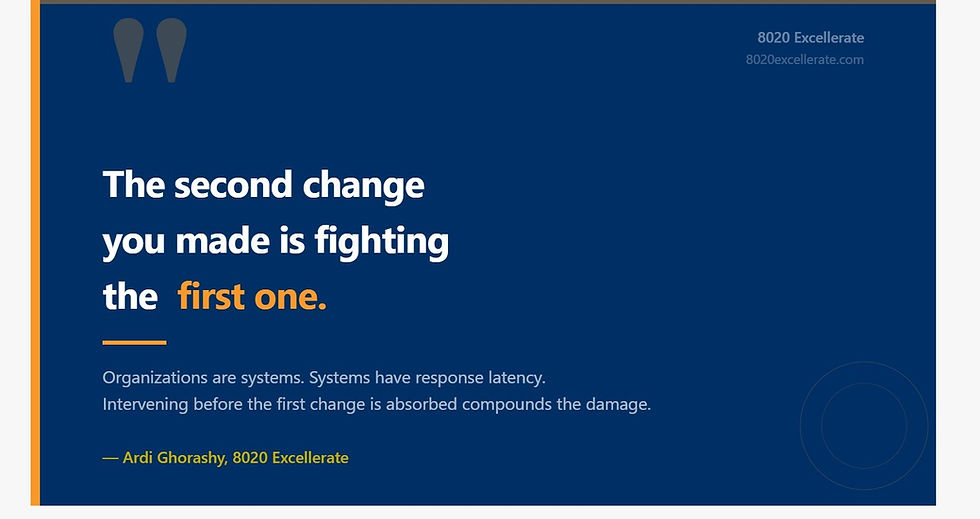
Organizations are systems. Systems have response latency. When you change a variable — a leader, a process, a structure, a priority — the system does not respond on your timeline. It responds on its own.
Most management teams understand this intellectually. Almost none account for it in practice.
The second intervention lands before the system has finished absorbing the first.
The second change you made is fighting the first one.
The third compounds the second. The organization is now perpetually mid-transition — never stabilizing, never getting a clean signal on what it is supposed to be doing.
The result is not slow progress. It is active regression.

Change Management Is the Missing Discipline
What turns a systems problem into a catastrophe: the absence of “real” change management.
Not a communications plan. Not a town hall. Not an email from the CEO.
Real change management is the disciplined work of moving people — their beliefs, their habits, their daily behaviors — from where they are to where the strategy requires them to be. It requires knowing which people are ready to move, which need development, and which are in roles that don't fit what the transformation actually needs from them.
The levers of organizational performance are generally well understood: market penetration, quote-to-close, labor and material management, billing rates, working capital, cost control. Organizations that struggle to move these levers rarely have a strategy problem. They have a people execution problem. Are the right people in the right roles with clear direction, and real capability to execute — that is the change management problem worth solving.
The Four Symptoms That Tell You It Has Already Gone Wrong
Change fatigue. People are absorbing too many changes simultaneously. Compliance without commitment. Going through the motions.
Directional confusion. The leaders in the middle have stopped believing any direction is permanent. So, they hedge instead of commit. They protect their teams and wait it out.
Credibility collapse. Trust bleeds out through accumulated inconsistency. By the time it is visible, it has been eroding for months.
Invisible disengagement. High performers haven't left yet. But they have checked out. The signal is there. It is just not on any dashboard.
What Works Instead
Understand this organization before you design the change. Not benchmarks. This company, this workforce, this culture. Survey the mid-level leaders. Map where decisions actually happen. Find the proponents — the people ready to move and capable of bringing others with them. Build from them.
Assess role fit before you develop people. Developing leaders who are in the wrong roles is not an investment — it is a delay. The hard, surgical work is getting the right people into the right seats before the transformation depends on them. A leader who is average in the wrong role can be exceptional in the right one. The reverse quietly undermines everything else.
Design the strategy around what this organization can realistically absorb. Transformation plans are built on financials and market position. They are rarely built with precise data on this organization's actual change capacity. Gather that data. Use it to sequence initiatives at a pace the system can process.
Grease the flow — don't change the direction. Once the direction is set and people are positioned, the job is to remove what is slowing the system's response — not to introduce a new direction because the current one hasn't produced results fast enough. Every directional change resets the clock and signals to the organization that nothing is permanent.
Develop the critical 20 to 30 people who carry the change through the organization. These are the directors and senior managers between the executive team and the front line. They are the transmission layer. When they lack the cognitive sophistication to hold complexity, the emotional intelligence to lead through uncertainty, or the communication skills to bring their teams through change, the transformation stalls. Developing these leaders is not merely an HR initiative. It is reinforcing the infrastructure on which every other initiative depends.
The System Is Responding
Organizations that consistently execute their transformation plans are not the ones with the best strategy. They are the ones who understood, before they began, that strategy moves at the speed of the people executing it.
You are not behind on your transformation. You are actually getting ahead of your organization.
The system is responding to the changes you made. It just cannot respond faster than the people inside it are ready to handle. That is the systems problem worth solving — and it is the one most transformation plans never address.
*Systems Thinking is one of the 60+ modules in 8020 Excellerate.
Ardi Ghorashy, M.Sc., PMP, PgMP is the Founder of 8020 Excellerate and Principal of 80/20 Consulting Inc. — a leadership consultant, executive coach, and former engineer with 35 years of experience across Americas, EMEA and SE Asia. He is currently embedded as part of a management team leading organizational transformation.
